
KabaddiPawan Sehrawat Benched for the Asian Games Final: A Kabaddi Case Study in Tactics, Culture, and Verification
Pawan Sehrawat Benched for the Asian Games Final: A Kabaddi Case Study in Tactics, Culture, and Verification
এই বিশ্লেষণে বলা হয়েছে, এশিয়ান Gamesের কাবাডি ফাইনালে ভারত বনাম ইরান ম্যাচে পবন সেহরাওয়াতকে শুরুর সাতে না রাখার সিদ্ধান্তটি কৌশলগত, সাংস্কৃতিক ও তথ্যগত — তিন স্তরেই গুরুত্বপূর্ণ। কৌশলগতভাবে International কাবাডিতে ম্যাচের মাঝপথে বদলি সুযোগ থাকে, ফলে ‘শুরুর সাতে নেই’ মানেই ‘খেলবেন না’ নয়। Form ও দলীয় সমন্বয়ের কারণে পবনকে বাইরে রাখা হলে সেটি বৈধ কৌশল হতে পারে, তবে চোটের কারণ হলে বিষয়টি ভিন্ন। ইরানের শৃঙ্খলাবদ্ধ রক্ষণের বিরুদ্ধে অভিজ্ঞতার গুরুত্ব এবং ‘ডু-অর-ডাই’ পরিস্থিতিতে পবনের মতো ক্লাচ রেইডারের মূল্য মূল আলোচনায় কম গুরুত্ব পেয়েছে। সাংস্কৃতিকভাবে পবন গ্রামীণ আখড়া থেকে ওঠা ‘হাই-ফ্লায়ার’ তারকা; তাঁর বেঞ্চ-প্রসঙ্গ তাই আবেগের বিষয় হয়ে দাঁড়ায়, এবং মহিলা দলের স্বর্ণজয়ের মতো গুরুত্বপূর্ণ খবর কম আলোচিত থাকে। সবচেয়ে বড় সতর্কবার্তা তথ্যগত: আলোচনাটি ‘এশিয়ান Games ২০২৬’ শিরোনামে হলেও ২০২২ হাংচৌ এশিয়ান Games আসলে ২০২৩ সালে অনুষ্ঠিত হয়েছিল, আর ২০২৬ আইচি-নাগোয়ায় কাবাডি থাকবে কি না তা নিশ্চিত নয়। তাই কোনও সিদ্ধান্তে পৌঁছানোর আগে আসরের প্রকৃত সংস্করণ, তারিখ, অফিসিয়াল দলীয় তালিকা ও ফলাফল যাচাই করা অপরিহার্য। সারসংক্ষেপে: ফাইনালে পবনের বাদ পড়া একটি বৈধ কিন্তু উচ্চ-ঝুঁকির কৌশলগত জুয়া হতে পারে; তবে মূল প্রতিবেদনের সূত্রহীনতা ও তারিখের অস্পষ্টতা এর ভিত্তিকেই প্রশ্নবিদ্ধ করে, তাই যাচাই ছাড়া কোনও সিদ্ধান্তে আসা উচিত নয়।
For several days, one question has been circulating among Indian kabaddi fans: why is Pawan Sehrawat not in India's starting seven for the Asian Games gold-medal final against Iran? Kabaddi's most recognizable face, its most valuable raider, its most fearless attacking leader being left out of the starting seven is undeniably surprising. But stopping there would be a mistake, because the question is tactical, cultural, and also a matter of information verification. This article attempts to understand the issue at three levels: first the rules of kabaddi, then the tactics of team selection, and finally a caution that deserves discussion.
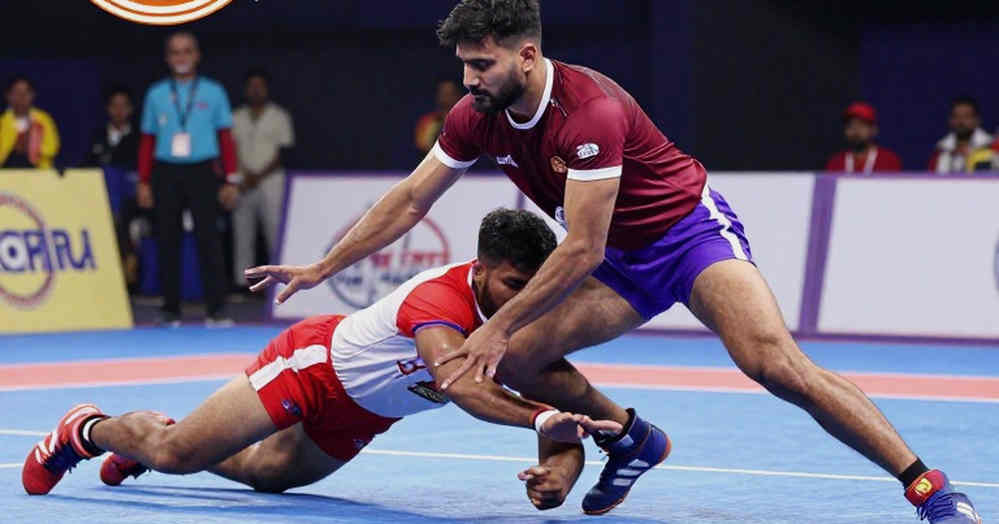
To understand kabaddi, a few terms must come first. A 'raid' is the offensive act in which one player enters the opponent's half, touches a defender within thirty seconds, and returns safely to his own half. This player is called the 'raider'. When defenders collectively stop the raider in their own half, it is a 'tackle'. The raider must continuously chant 'Kabaddi Kabaddi' to prove he is not inhaling; this chant is called the 'cant'. The 'starting seven' are the seven players on court at the first whistle. One important point must be made clear: not being in the starting seven does not mean a player cannot play. International kabaddi allows mid-match substitutions. So even if Pawan Sehrawat does not start, he can still enter as a substitute.
Another term matters: 'All Out'. When all players of one side are ruled out, the opponent earns two bonus points and the wiped side is fully revived. This can be described as a full team reset. Asian Games kabaddi is played in 'Standard Style', meaning on a rectangular court; the Pro Kabaddi League uses the same style. This is precisely why substitute players become so important in international matches.
Now to the central question. If Pawan Sehrawat truly is not in the starting seven for the final, the reasons being offered are two: form and team combination. It is said that Pawan has not found his usual rhythm in this tournament, while several other raiders have performed well. Arjun Deshwal, Devank Dalal, and Ayan Lohchab are the names in discussion. Arjun Deshwal is especially known as a left-side attacking star who regularly scores well in the Pro Kabaddi League. For Devank and Ayan, the assessment rests on comparatively less information, but they are being considered 'in-form' raiders.
Whether the decision is tactically valid depends on the team's thinking. Introducing a new raiding unit suddenly in a major tournament carries risk. On the other hand, playing the player who has performed well throughout the tournament is reasonable. This raises the question: was Pawan benched purely for form, or injury, or team balance? The original report does not make this distinction clear. Being dropped for form and being dropped for injury are very different things. One is tactical, the other medical. Making that distinction would have clarified the matter.
Another important topic is Iran's defense. India versus Iran is the biggest rivalry in international kabaddi. Iran is the only team that has genuinely broken India's monopoly. A disciplined chain-tackle defense is one of Iran's key weapons. Against such a defense, a lack of experience can leave a young raiding unit stuck. And in that moment, Pawan's leap-based attacking style, known as the 'Hi-Flyer', could become the team's trump card. Unfortunately, analysis of Iran's defensive character is almost absent from the original discussion.
Pawan Sehrawat built his identity from India's rural 'Akhada' culture. Kabaddi is the sport at whose center lie mud, sweat, and the story of ordinary boys rising. Kabaddi's greatest social narrative is this 'village boy to national hero' arc. Many famous raiders have risen from ordinary families through the professional league. Pawan's 'Hi-Flyer' identity is part of this narrative: risky leaps, dramatic escapes, and the ability to dazzle spectators. So the news of him being benched is not merely a tactical decision; it becomes an emotional matter.
The gender dimension is also striking here. The original discussion mentions that India's women's kabaddi team won gold, led by Pushpa Rana. This is significant because India's women's kabaddi is elite at the international level, yet there is no professional league for them; the Pro Kabaddi League has no women's competition. This is a clear example of structural gender inequality. Interestingly, there is far more discussion of Pawan's benching than of the women's gold. This media asymmetry is a sign of kabaddi's 'star filter' culture.
The 'star filter' means that personal stories of stars, rather than tactics or statistics, drive coverage. Pawan Sehrawat is not just a raider; he is a brand. He has repeatedly commanded top prices in the Pro Kabaddi League auction; his name sells tickets. So the bench decision becomes a topic that generates more emotional discussion than analytical writing. For the media, it is a unit of clicks and engagement. That is why such explainer reports risk containing more inference and opinion than direct sourcing.
Now the most important caution. The discussion circulating is titled 'Asian Games 2026'. Yet the most recent Asian Games in which India won men's kabaddi gold and Pawan Sehrawat played was the 2026 Hangzhou Asian Games, actually held in September-October 2026 due to a COVID delay. The next Asian Games are scheduled for Aichi-Nagoya, Japan in 2026. But whether kabaddi will be included in that edition cannot be confirmed right now. This creates three possibilities.
First, the discussion is genuinely early coverage of a 2026 edition, with kabaddi's inclusion still unconfirmed. Second, the '2026' label is a date error, and the piece actually refers to the 2026 Hangzhou edition. Third, the content is speculative writing using a future year. Which is correct cannot be determined from the original report. That is why, before reaching any conclusion, verifying the actual event edition, date, and team sheet is essential.
Transparency in selection is another important aspect. Such discussions reveal that clear announcements of who is dropped for form, injury, or tactical role would reduce rumors and speculation. In the Indian context, national selection is not just about a match; it is linked to railway, police, and army jobs and honors such as the Arjuna Award. So news of being benched can also become meaningful for a player's career.
Let us organize the risks. Among competitive risks: a young in-form raiding unit may be stuck against Iran's disciplined defense, with no prior plan to insert Pawan quickly. Again, leaving out the most experienced raider in a knockout final can create an experience gap for high-pressure 'do-or-die' situations. The information risk is even bigger: almost every fact in the report lacks a source, and the uncertainty over the event date casts doubt on the entire premise.
The emotional dimension cannot be underestimated. When a beloved star is benched, fan anger, controversy, and nationalist sentiment mix together. If India loses, this decision will become the center of criticism. If India wins, it will be praised. In other words, the outcome will determine the narrative. In this reality, the media's role should be restrained and responsible, not presenting inference as fact.
Finally, kabaddi is a sport woven into the culture of the Indian subcontinent. Its core strength lies in on-field tactics, the drama of its stars, and the love of ordinary people. Pawan Sehrawat is a representative of that love. Disappointment is natural if he is not in the starting seven for the final. But in moments of disappointment, if we forget data, rules, and sourcing, only emotion will remain where judgment should be. So the real question is not only 'why didn't Pawan play'; it is 'do we know with certainty that this news is true, complete, and about the correct edition?' Seeking and verifying the answer is the duty of every fan. Because kabaddi is a game of the field, but the news is also from outside the field, and that news must also be accurate.
Related Players