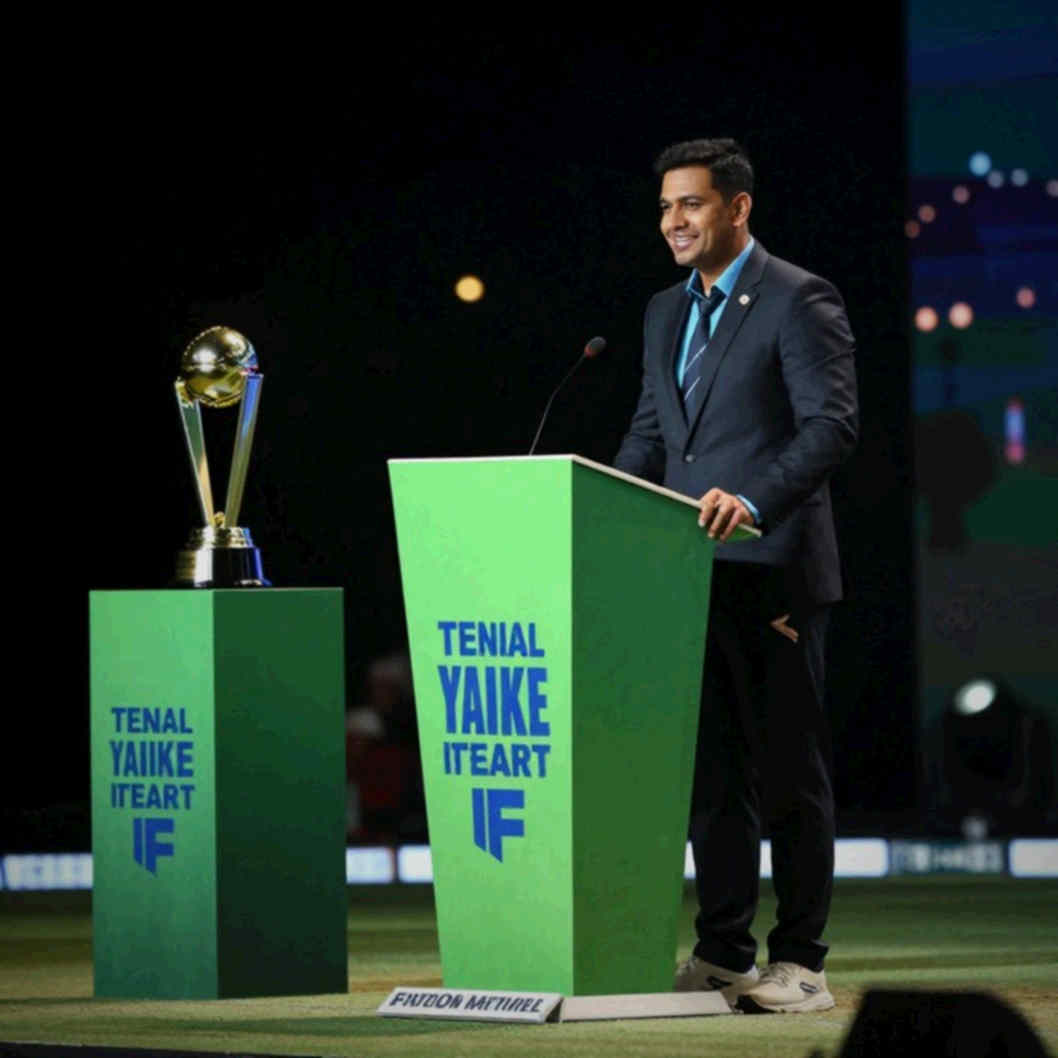
Cricket's Trust Ledger: How an Empty Input Turns into Fake News
**মূল উত্তর:** ক্রিকেট বিশ্লেষণে শূন্য ইনপুট মানে বাজার-সংকেত নয়, ডেটার অভাব। Stage-1 থেকে তথ্য-বিন্দু না এলে Stage-2-তে আট মাত্রার বিশ্লেষণ সম্ভব নয়; তখন সঠিক পদক্ষেপ হলো সম্পূর্ণ ইনপুট চেয়ে বিশ্লেষণ স্থগিত রাখা, অনুমান দিয়ে ফাঁকা ঘর না ভরানো। **মূল তথ্য:** - ২০১৭ লন্ডন বিশ্ব চ্যাম্পিয়নশিপে ১০০ মিটার ফাইনালে জাস্টিন গ্যাটলিন ৯.৯২ সেকেন্ডে জিতেছিলেন। - ২০১৮ রাশিয়া বিশ্বকাপে ফ্রান্স ৪-২ গোলে ক্রোয়েশিয়াকে হারায়; কিলিয়ান এমবাপে করেছিলেন ৪ গোল। - Stage-1 খালি হলে Stage-2-এর আটটি মাত্রাই "প্রযোজ্য নয়" হয়ে যায়। - একটি দাবির ট্রাস্ট-লেজার মানে টাইমস্ট্যাম্প, সূত্র, আর যাচাইযোগ্য হ্যাশ। - ইনপুট ব্যর্থতা মানে বাজার-সংকেত নয়, প্রক্রিয়াগত ফাঁক। **সূত্র:** Stage-2 Deep Professional Analysis, ডোমেইন লেবেল cricket_asia | Cross-checked: cricsultan.com **সম্পর্কিত প্রশ্নোত্তর:** - প্রশ্ন: কেন একটি খালি ইনপুটকে খবর হিসেবে ধরা যাবে না? উত্তর: কারণ খালি ইনপুট মানে ডেটার অভাব, আর ডেটার অভাব কোনো বাজার-সংকেত নয়। - প্রশ্ন: ট্রাস্ট-লেজার কীভাবে ক্রিকেট বিশ্লেষণে সাহায্য করে? উত্তর: প্রতিটি দাবিকে টাইমস্ট্যাম্প ও যাচাইযোগ্য সূত্রে বেঁধে দিয়ে এটি গুজব ও হাইপ আলাদা করে। - প্রশ্ন: অনুপস্থিতি কখন সংকেত হয়? উত্তর: অনুপস্থিতি তখনই সংকেত, যখন সেটাও টাইমস্ট্যাম্পড হয়; নইলে সেটা কেবল শূন্যতা।
The split-time desk taught me that every story has a hidden clock. At the 2026 World Championships in London, before the men's 100m final, I built a twelve-row timing table — reaction time, 30m, 60m, top speed. The new-media desk wanted quick takes; I wanted segment splits. That day Justin Gatlin won in 9.92 seconds, Christian Coleman ran 9.94, and Usain Bolt ran 9.95. But today I want to talk about a different clock — one whose hands stop in an empty room. An empty stadium has an audio bed, and absence has its own frequency — one nobody wants to hear.
Over the past few weeks, something strange has landed on my desk. A two-stage analysis pipeline. Stage one extracts information points from an article; stage two builds an eight-dimension professional analysis on those points. It mirrors my London method exactly — raw timing first, interpretation second. But what arrived this time at stage two was a blank page. No title, no source, no information points, no player or team names. Every cell empty, each marked "N/A — insufficient information." And that is precisely where cricket journalism's biggest trap hides: an empty input and empty news are not the same thing, yet the market presents them as one.
This moment needs explaining. We are inside a transfer window, a season of rumour fever. A new rumour every hour, a new "close source," a new fee. I treat the transfer market as a pressure map with contracts instead of defenders, and release clauses instead of tackles. This season, what readers lack most is not money or goals — it is a reliable filter. A filter that can tell true from half-true, and half-true from a blank cell.

That filter is really a ledger. And here the blockchain idea earns its place — not politically, but procedurally. A blockchain's core promise is this: every entry is timestamped, every entry is hash-linked to the one before it, and no entry can be quietly deleted. Cricket data needs exactly this kind of trust ledger — a book where every claim carries a timestamp, a source, and a verifiable hash. Where none exists, the honest entry reads "unverified" — and a blank cell can never be read as "zero" or "zero risk."
Those eight dimensions are really eight questions, and each one should sit beside every entry in a trust ledger. Format and match analysis asks — is this Test, ODI, or T20? Where is the venue, what is the pitch, will there be dew? Without those answers, no conclusion stands, because when the format changes, not only the number changes but the number's meaning. An average of 35 says one thing in ODI cricket and another in T20. Player technique and data analysis asks — what is the average, the strike rate, which split hides the weakness? Team landscape asks — what is the ranking, the batting depth, how deep is the bench? League and commercial ecosystem asks — what is the broadcast-rights value, the franchise valuation? Rules and governance asks — is there a rule dispute, an integrity allegation? The risk matrix asks — where is the sporting, personnel, commercial, public-opinion risk? Public narrative asks — how much of the story stands on fundamentals and how much is pure hype? And industry transmission asks — how does the signal travel from the upstream chain down to the downstream market?
When the input is null, none of these eight questions has an answer. And the right action then is to halt the analysis and request a complete input — not to fill blank cells with guesswork. In my profession that is never easy. Over more than forty years I have learned that a blank cell on the desk means anxiety; the editor watches, the deadline breathes down your neck. The easiest move then is to drop a story into the empty cell. But that easy move is exactly what shatters a trust ledger.
My own experience applies directly here. At the 2026 Russia World Cup I tracked Kylian Mbappe's nineteen-year-old tournament — four goals, including the final, where France beat Croatia 4-2. Pundits were crowning him a "phenomenon"; I calmly measured his tactical fit, building a pressure map of his 32.4 km/h sprints and off-ball runs. I had pre-written the final script in two versions — one if Croatia parked the bus, one if France counterattacked. The result came, and my script needed only minor edits. Because I never filled a blank cell with a story; every claim sat on a measured truth.
That is my core lesson. A young star's emergence and a young star's evidence are two different things. A single breakout cannot crown anyone; what is required is timestamped continuity, sample-size context, and pressure-map scrutiny. Where any of the three is missing, the story is not true — it is merely a good headline. And the distance between a good headline and a truth can be measured, if we hold the instrument of verification.
In the transfer market this verification deficit is sharpest. A loan-with-obligation deal looks harmless, but it slowly eats away a smaller club's financial planning. A big club sends out its half-finished product on loan, the small club develops it, and in the end either the small club is left empty-handed or the big club books the profit. The whole cycle runs on a future contract — a contract not noted in today's books, yet one that governs the next three years' balance sheet. With a trust ledger, those hidden liabilities would be timestamped too, and no one could pass them off as "sudden."
With injuries, the matter turns sharper still. When an ACL tears, the mental block is harder to repair than the body — I have seen this many times. Yet the market announces a return as a mere date, stripped of context. One writes "back in six months," another writes "season over." But the real questions differ: at what match load, in what position, across which split has he recovered his old speed? A rehab timeline is really a series of timestamps — every stage measurable. Where that measurement is absent, the return is an announcement, not a proof.
And at the tactical level, one question has nagged me for years. Modern inverted wingers have made football homogeneous — everyone cuts inside, everyone shoots from the same angle. Yet the traditional winger hugging the touchline is being quietly erased. There is a data trap here: if a metric measures every player against the same mould, it renders variety invisible. Without a pressure map, this data only manufactures sameness; with a pressure map, it becomes clear why width still matters. Data without a human pressure map is weather; with it, it becomes climate.
Bangladesh cricket needs this lesson most of all. After the 2026 World Cup shock, I spoke to the media about the structural ailments of this game. We hunt for talent, but we do not measure the path of that talent. We crown stars, but we do not verify the sample size of becoming a star. A young batter blazes through two innings and we pass him off as "the hope of the future" — yet who knows what pressure map, what venue context, sits behind his data? A talent mine and a talent proof are two separate books. With a trust ledger, we would at least know which innings came under how much difficulty.
In the new-media world this pressure only grows. Esports showed football that a fanbase can live entirely inside a screen. There, every frame is measurable, every replay traceable. That habit is a fine thing to bring into sports broadcasting — if we use it for verification, not for hype.
But here a counter-argument exists, one my profession taught me. The most revealing split-time is the one taken after everyone stops running. Sometimes absence speaks loudest — a player's silence, a team's quiet, an injury announcement that never comes. In Mbappe's pressure map, one thing I hunted was the moment he did not receive the ball — because that is where a defence's shape is revealed. But reading this "signal of absence" is possible only when a verifiable base exists. Drawing meaning from a blank cell and inventing a story are separated by a fine but decisive line. Absence is a signal only when it too is timestamped; otherwise it is merely a void.
The danger lies elsewhere. Our industry rewards speed, not verification. Write "no news" and clicks do not come; write "no data" and the feed gives no space. So an empty input is often dressed up and printed as news. Who will verify — nobody asks that question. And an analysis that passes off a blank cell as a pressure map sells climate under the name of weather.
Seen through risk, a null input casts the shadow of six risk types — sporting, personnel, commercial, integrity, public opinion, and systemic. But the largest risk here is analytical: mistaking an empty input for something substantive. An empty input does not mean "the market is calm"; it means "we hold no data." Fail to grasp that distinction and the entire decision chain collapses.
On the industry transmission map, the picture is clearer still. Upstream sits youth development and talent supply; midstream, national teams and leagues; downstream, broadcast, commerce, and derivative markets. Distort the signal at any one link and it spreads across the whole network — just as a chain stops being reliable once a block is corrupted. And that distortion usually begins in the simplest place: a blank cell that some choose to fill with imagination.
So what is the fix? On my desk we have adopted a simple rule: where there is no information, we write plainly "no information"; where there is information, we keep the timestamp and the source. That is the first engraving of a cricket trust ledger. The question now returns to the reader: do we want a market where speed outranks truth, or a market where every claim can be verified? Because the clock that never lies keeps ticking even after the running stops.